
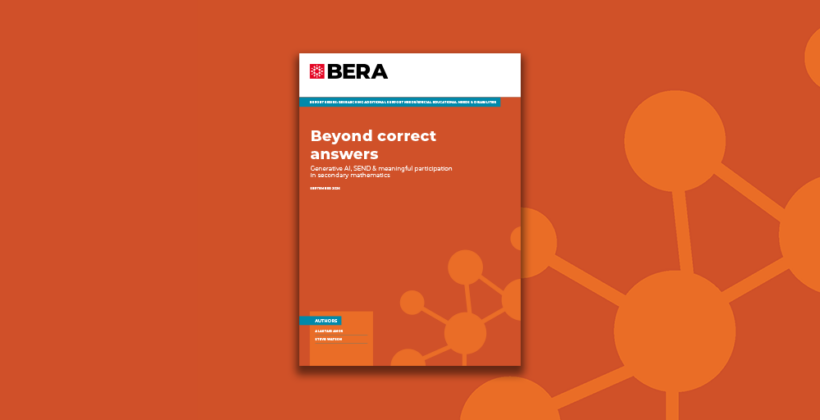
BERA has published Beyond correct answers: Generative AI, SEND & meaningful participation in secondary mathematics, by Alastair Amos and Steven Watson. Released on 18 September 2026, the report is part of the British Educational Research Association’s 2025/26 Small Grants Fund series on additional support needs and special educational needs and disabilities.
The research asks a practical question for schools: when students use generative AI in mathematics, what helps them stay meaningfully involved in the thinking?
What the study found
The small practitioner inquiry involved two secondary students with SEND. AI was useful when it addressed a particular uncertainty. Learning became harder when responses moved too quickly, contained too much information or failed to connect with what the student already understood.
Teachers played a crucial role in repairing these difficulties: reconnecting explanations to familiar methods and helping important ideas carry through a sequence of work. The report therefore treats AI use as an interaction involving the learner, the teacher and the technology.
Its recommendations include explicit teaching about how to use AI, supported access for students with SEND, teacher development, and tools designed for manageable steps and sustained engagement. With two participants, this is an exploratory study; it does not establish a general effect on attainment or represent every learner with SEND.
The related BERA blog. In Beyond correct answers: AI, classroom interaction and inclusion in mathematics (24 August 2026), Amos and Watson illustrate these questions through classroom examples. One learner needed help connecting algebraic notation with repeated addition; another wanted to explore when division by an expression is valid. The blog shows how an efficient AI response can miss the mathematical question a learner is pursuing, and why teachers’ work in making explanations usable matters for inclusion.
Why this matters for EdgeLab
For EdgeLab, the findings open a conversation about the conditions that make an explanation usable. A response can be available on screen while the learner still needs time, a different representation or a teacher’s intervention to work with it.
Our Autopoietic Ecology perspective directs attention to how these conditions develop across interactions. This is EdgeLab’s interpretation of the study’s significance: evaluating educational AI requires attention to what learners can do next, how difficulties are noticed and how support is renewed over time.
Congratulations to Alastair Amos on the publication, and thanks to BERA for supporting and publishing this collaborative research.
Read the research
- Read and download the report from BERA.
- Explore BERA’s Small Grants Fund report series.
- Read the authors’ related BERA blog on AI, classroom interaction and inclusion.
- Read EdgeLab’s earlier discussion of the project.
Report artwork: British Educational Research Association (BERA), 2026.
Leave a Reply